

Tag Archives: think-tank

Mediterranean: FEMISE shines a spotlight on Women and Young “Change Makers” 1/2

On the occasion of the Emerging Valley summit, which was held on December 3-5 in Aix en Provence (France), FEMISE and Institut de la Méditerranée organized a workshop on women and young “Change Makers” in the Mediterranean region. Ecomnews Med was there and below are our highlights.

Jordan, Lebanon, Morocco, Palestine, Tunisia, Egypt… Delegations came from all around the Mediterranean for this day. Women and young people, often both at the same time, were there to “exchange experiences” as notes Layla Al Qassim, who came from Amman for the occasion. First a reflection, drawn up by the Secretary General of FEMISE Dr. Constantin Tsakas “We observe inequalities on all fronts in the Mediterranean, however we also find that there are many women and young people who are carriers of real solutions”.

In line with what the Think Tank has been offering for several years now, FEMISE thus traveled to the Mediterranean countries to “identify Change Makers“, adds Dr Tsakas. The objective is to be present in the field to propose concrete solutions, to carry out Research-Action which promotes good practices while offering relevant recommendations. Evidently, in the image of the Med briefs produced by FEMISE, it is a question of proposing findings, ideas, reflections, which could be used for political decision-making for more inclusiveness in the Mediterranean.

Constantin Tsakas, Patricia Augier, Layla Al-Qasim, Karine Moukaddem, A’Laa Chbaro, Samah Ben Dhia, Hajar Khamlichi, Chiraz Karoui

“We need research that caters to the needs of populations”

During the numerous FEMISE trips, the Secretary General admits having met “many women who are carriers of solutions. These women and young people direct, support and finance projects that have a considerable economic and social impact on their communities, regions and industries. ” This is also where the idea for this workshop was born. The Think tank wants to put the spotlight on these different women “because we believe in success stories a lot” abounds Dr Tsakas. Layla Al Qassim for example (see video above) was able to discuss the various progresses made within the Landmark Hotels chain of hotels in Jordan, for which she is responsible for strategic engagement and sustainability projects, such as “the establishment of a free nursery accessible to all employees“.

An idea already in place in several American or Scandinavian companies, and which benefits employees and employers. The former have less distance to travel to drop off the children and are less stressed. The latter benefit from higher productivity, since the employee is less under pressure.

But it is above all a concrete and quickly applicable idea as “we need research close to the expectations of the population” underlines Karine Moukaddem, junior researcher at Beyond Reform and Development and political analyst attached to FEMISE. The Mediterranean sustainable development expert is convinced of this, research close to expectations allows “political actions that are close to the realities of the population“.

This observation is shared by A’Laa Chbaro, who also underlines the need to restore ambition in Mediterranean women and give them the confidence to get started. Skills development and knowledge sharing are key factors that the young 23-year-old entrepreneur, director of the MENA branch of the international association Impact the world, seeks to develop.

The workshop ultimately helped to build bridges and decompartmentalize worlds, as often with FEMISE, between research and application on the ground, because it is well known after all, experience and science always progress together.

In a second part of this article, we will focus on the speakers at the IM / FEMISE workshop who support initiatives led by women and young people in other fields, such as in environmental awareness and in the media.

by Sami Bouzid, 

Article produced in partnership with EcomNews Med.

Find all the information from the Mediterranean think tank by clicking here.
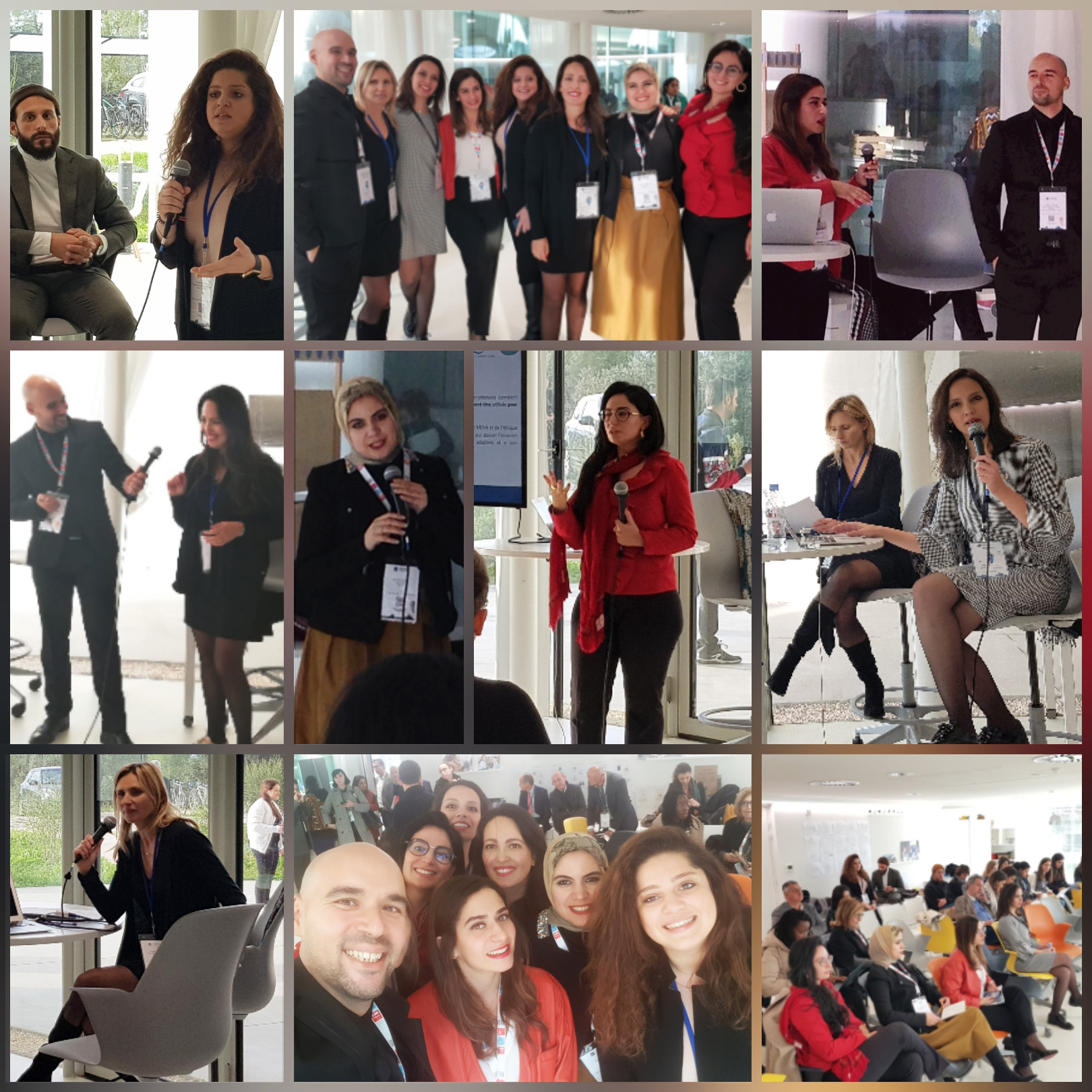
Moments from the IM/FEMISE workshop at EV2019 :Empowering Women and Youth Leaders in the Mediterranean and Africa (Dec 4th, TheCamp, Aix-en-Pce)

Med Change Makers e08 : Vera DANILINA, Green Public Procurement Vs. Environmental taxation: potential for EuroMed environmental cooperation


FEMISE launched in 2018 its series of interviews called « Med Change Makers ».

« Med Change Makers » are text and video-based interviews that allow dynamic researchers of the FEMISE network to illustrate how their research addresses a policy-relevant question and how it contributes to the policy-making process in the Euro-Mediterranean region.


Green Public Procurement Vs. Environmental taxation: potential for euro-mediterranean environmental cooperation

Interview with Vera Danilina, Aix-Marseille Université and FEMISE

Environmental issues are among the priorities of FEMISE research / action. In the Mediterranean, the consequences of climate change will always be stronger than elsewhere. The reduction of greenhouse gas emissions and the adaptation needs of bordering countries are more than ever necessary.

Author of a FEMISE MED BRIEF, Vera Danilina focuses on environmental taxation and green public procurement (GPP). She provides a comparative analysis of their effectiveness and reveals the opportunities for harmonized environmental policy between countries. Her results suggest specific implications for environmental collaboration between EU countries and those of the MENA region (Middle East and North Africa). Interview :

1. Your recent FEMISE Brief is focused on the comparison between GPP and environmental taxation. What are these two policy instruments and why do you focus on them ?

The first instrument is Green Public Procurement and is related to the process whereby public authorities seek to procure goods and services with reduced environmental impact. Accordingly, it corresponds to their initiative to consume eco-friendly products. This policy instrument is relatively new: within the EU the importance of GPP was stressed in 2003 when the member states were urged to adopt national plans for greening the public purchasing policy. Despite the relatively slow development of GPP, 55% of the contracts signed by European public authorities in 2009/10 included at least one EU core GPP criterion.

The second instrument, which is the environmental tax, targets directly the negative impact of production. Nowadays, in the EU-28 such taxes account from 30-50% (UK, Belgium, Italy, Denmark) to 60-80% (Germany, France, Norway) and even to 80-100% (Spain, Liechtenstein) of all key environmental policy instruments in use. Environmental taxation accounts for 2.4% of the EU-28’s GDP varying from 0.77% in Liechtenstein to 4.14% in Denmark.

Why focus on these two policy instruments? First of all, because they belong to alternative approaches to regulation that feature mandatory vs. voluntary participation and direct vs. indirect influence. The second reason is that while environmental tax can be considered as one of the most or even the most widely used policy instruments, the expansion of GPP is much more modest. But at the same time, GPP has been constantly high on the policy agenda of different countries since 1970s that shows its expected potential in the environmental policy development. Thus, the main reason to choose taxes and GPP for our analysis is to investigate the pros and cons of a traditional and a relatively innovative policy instrument exploring their possible complementarity or/and substitutability.

2. Are economic instruments for environmental policies widespread in Mediterranean countries of the South shore and why (not) ? Are there South-Med success-stories ?

The South-Med countries are mostly focused on the environmental taxation as the more transparent and straightforward instrument: it represents from 64% (Israel) to 100% (Egypt, Tunisia) of key environmental policy instruments toolkits. Meanwhile, in the majority of countries they represent a relatively modest share of GDP. At the same time in Israel green taxes account for 3% of GDP and 2% – in Morocco which is in line with European practices.

Public purchasing accounts for around 18% of GDP within the MENA region indicating a significant potential to influence markets and industries. Green procurement is not widely developed though. However, we would mention such countries as Israel, Egypt, Morocco and United Arab Emirates as leaders in GPP movement. According to the Ecolabel Index, there are up to 20 eco-labels in each of these countries including such nationally developed green standards as “Green Star” label for the responsible tourism in Egypt or a multi-industrial Israeli Green Label. These countries have also launched a range of governmental programmes supporting eco-innovations.

In general, environmental regulation is not well-developed in the South-Med countries. Among the reasons we would mention a wide range of social and economic problems that seem to be more urgent. At the same time we observe the development of environmental policies that indicates the growing understanding of their importance.

3. How can environmental policies and instruments in the South Med co-exist with the social and economic difficulties these countries are facing ?

It is well-known that the South Med region experiences a wide range of social and economic difficulties that might seem to be much more important than ecological threats. At the same time, the costs of environmental degradation for this region ranges from 2-3 % of GDP in Tunisia, Jordan, and Syria, to 5-7 % of GDP in Egypt and Iran. These figures are impressive. They assure that without developing green policy, the South Med countries risk to deepen not only the ecological problems but also the social and economic difficulties.

Moreover, focusing on economic development without corresponding environmental restrictions could potentially aggravate environmental degradation worsening the quality of life of the population. As an example, we would particularly stress health problem that can drastically reduce GDP. The link between environment, health, and GDP is potentially strong in the absence of environmental regulation and in the presence of “basic” threats such as car emissions, for example, that most directly affect the population.

4. How important is the coordination of environmental policies across South Mediterranean countries and why ? What direct and indirect benefits ?

Our research urges for the policy harmonisation across trading countries. We see this strategy as a first-best or a “win-win” option that allows the actors to coordinate their environmental efforts without implicating any disproportional burden to any of them.

Otherwise, the countries who focus more on the environmental regulation could be demotivated by the return effect of international trade. Thus, the country who opts for more severe environmental taxation wins from trade integration with the country who introduces GPP or lower taxation. In the literature this phenomena corresponds to a “pollution haven effect” by which trade integration makes polluting industries move from countries with more severe to countries with less severe environmental regulation, while not necessarily leading to the reduction of global environmental degradation. If all countries opt for the GPP policy, the more environmentally virtuous country whose government spends more on green goods faces purchasing power decline while the less environmentally virtuous country whose government is less generous in environmental spendings gains. In our research we call this result a “paradox of virtue”.

Last but not the least is the argument of trade and environment complementarity. When environmental policies are identical both in their type and stringency, trade integration leaves the environmental degradation level unchanged but incurs an increase in purchasing power across trading countries.

Consequently, on the side of direct benefits of policy harmonisation we would mention environmental degradation decline and the equality of the policy burden. Talking about the indirect effect, we definitely stress the positive effects of the regulation to the business traditions as well as consumer preferences. Even more, harmonised policy implies the harmonisation of eco-standards across countries that simplifies the cross-country cooperation, joint ventures development, and public control.

5. How can collaborating with the EU, within the framework of EuroMed cooperation, provide answers to environmental concerns ?

The EU is known for its well-developed system of environmental regulation that can be seen as one of the examples to spread to the South-Med countries. Both the public and the private institutions of the EU contribute to the system of eco-labelling and eco-certification, influencing the choice made by consumers and enterprises. Thus, Germany and Austria are the pioneers of GPP programmes. Since 2008 the European Commission has developed more than 20 common GPP criteria covering a wide range of sectors.

The EU has also proposed criteria of two different types, core and comprehensive. Core criteria address the key ecological impacts and are easy to get verified while comprehensive criteria are stricter and more complex requiring additional verification efforts. The variety of criteria guarantees the flexibility of the GPP strategy that can be tailored to the needs of a particular industry and country.

6. Are there other frameworks of cooperation (regional, bilateral) that can benefit the South ?

We particularly stress coordinated GPP as a form of cross-country environmental support. Our research shows that GPP can be related to the environmental support across countries when one can be a donor, and another one – a recipient. A country that has higher financial and institutional capacity to develop GPP can increase its green public spending allowing a country that has lower financial and institutional capacity to develop GPP to benefit from the green demand of the partner country. Donors are in the position to set the standards and quality control that allows to diminish or even avoid greenwashing and, at the same time, propagate the corresponding ecological standards to the recipient. By getting accepted, the environmental criteria system could uniform the rules for companies in all participating countries facilitating their access to the markets and diminish the environmental degradation. This approach could be considered for the collaboration of EU and MENA countries in order to strengthen the environmental policies in the latter and establish a first step towards the harmonisation of green policy approaches.

7. What is your top-recommendation for South Med officials ?

First of all, we recommend the wide implementation of GPP as an efficient approach to environmental policy design. Despite being a voluntary tool, it can motivate firms to opt for green technologies even when the only incentive is originated from the government. The effect can be amplified by taking into account the consumers eco-biased demand that, in its turn, can be boosted by the corresponding public policy. At the same time, GPP is not risk-free: the absence of public monitoring can diminish the positive effect of the policy approach allowing firms to greenwash, or cheat on the environmental quality of their products. Accordingly, a corresponding monitoring policy is required.

Second main recommendation is to opt for the long-term environmental policy harmonisation even across countries with different level of economic and institutional capacity to introduce symmetric policy instruments.

The coordination of environmental policies is of particular importance for the South Mediterranean countries in view of meeting the Sustainable Development Goals (the UN, 2015), as well as for two following reasons. First, a relatively low share of intra-regional trade with the EU which is expected to increase due to the current policy agenda of the Euro-Mediterranean trade partnership. Thus, further trade liberalisation will increase the opportunities for cross-region cooperation and an environmental policies harmonisation could be key to avoid the above mentioned “pollution haven effect”. Second, the decline in economic growth in the MENA region that could potentially be partially restored with the contribution of a deeper trade integration. At the same time the environmental degradation increase that might correspond to economic growth can be mitigated by the environmental policies coordination.

Interview by Constantin Tsakas

This activity received financial support from the European Union through the FEMISE project on “Support to Economic Research, studies and dialogues of the Euro-Mediterranean Partnership”. Any views expressed are the sole responsibility of the speakers.